Christmas Festivities !

This December, the LAI team celebrated the holiday season in a special and memorable way. Members of the lab from around the world organized an international feast to highlight the varied culinary traditions of our team. It was a day full with laughter and a variety of flavors, representing our collective journey through a great year. Here’s to the memories we’ve made and the thrilling adventures that await us!

LAI celebrates Achyuth Acharya’s thesis!

On the 11th of December, Achyuth Acharya successfully defend his work titled ‘Multiscale Characterization of Human Muscle Differentiation in vitro and the Influence of Mechanical Stimuli‘. The defense took place in front of a distinguished jury comprising experts in the field: Edgar Gomes, Delphine Duprez, Sylvain Gabrielle, and Sophie Chauvet.

Achyuth began his journey with IBDM and LAI as a Centuri student under the guidance of Frank Schnorrer from IBDM and Olivier Theodoly from LAI. He has now advanced to the next stage of his academic journey. He will be continuing his impactful project as a post-doc at IBDM, and we extend our heartfelt congratulations and best wishes to him.

Best of luck, Achyuth!

CNRS IRP : Aaron Cruz-Ramirez is visiting LAI

We are happy to welcome Aarón Cruz Ramírez, who runs the micro- and nano-fabrication facilities at the National Autonomous University of Mexico (UNAM).

During his visit, we had the pleasure of showcasing force-based techniques. Aarón also demonstrated his craftsmanship by creating nanoscribe surfaces, including a small surface featuring the LAI logo. To top it off, he shared valuable insights into his impressive work with our lab.

Valentine Seveau de Noray wins prestigious “Accessit du Prix Daniel Guinier” from SFP for her outsanding research!

We are delighted to share the remarkable achievement of Valentine Seveau de Noray, who has been honored with the “Accessit au prix Daniel Guinier” for the year 2022. This prestigious award is presented annually by the French Physical Society (SFP) to young physicists for their exceptional research during their doctoral studies.

Valentine’s dedication and innovative contributions to the field have earned her a second prize, a testament to her unwavering commitment to advancing scientific knowledge. Valentine finished her thesis “Quantitative study of cell guidance in controlled microenvironments: atypical cases of rheotaxis and adhesive haptotaxis” under the guidance of Olivier Theodoly and Marie-Pierre Valignat.

Congratulations, Valentine!

For more details on Valentine’s research and the award, please visit the link below: http://sfpnet.fr/baptiste-bienvenu-et-valentine-seveau-de-noray-accessits-aux-grands-prix-de-these-2022-de-la-sfp

A new article on OT_Analysis: a software for rich analysis of force curves when probing living cells with optical tweezers

Optical tweezers are a light-based technique for micromanipulating objects. It allows to move objects such as microbeads and cells, and to record minute forces down to a few pN, which makes it a technique very well adapted to mechanical measurements on living cells (Gennerich, 2017). We are interested in the mechanotransduction properties of lymphocytes. We seek to dissect the effect of forces and cell mechanics on the cellular response, in the context of the immune system. T cell mechanotransduction has been recently demonstrated to be instrumental in the finesse and accuracy of the response of the latter Puech & Bongrand (2021)]. In addition, cells can exert forces when performing their action, e.g. cytotoxic T cells are using forces to kill target infected cells (Basu et al., 2016).
Using optical tweezers and specifically decorated beads as handles, we pull membrane nano- tubes from gently adhered living lymphocytes (Sadoun et al., 2020). Such nanotubes are usually used to probe the tension of adherent cells (Diz-Muñoz et al., 2010). By varying the antibodies that are used to decorate the beads, we select the molecule type we specifically pull on, and we then explore the molecules which are characteristic of the immune synapse, which is one of the key organizational structures that have profound implications in T cell recognition and action (Baldari & Dustin, 2017).
Using this approach, we probe not only the forces of recognition of the given antibody to its target molecule, but also, by using strong extracellular bridges, we probe the cytosolic link of the probed molecule to the cytoskeleton. Such a link has been proposed to be instrumental in the way T cells can apply or feel forces through the molecule. A theoretical model has been built and has been recently reported in a dedicated article (Manca et al., 2023). Furthermore, we will demonstrate the application of the software on full data.

The experimentally obtained data consists of force signal as a function of time (among other parameters), in the three directions of space, obtained in large quantities (at least 10 per cell / bead couple, and up to 20 couples tested per sample), containing rich and detailed features that can relate to molecular and/or cellular mechanics that our model explores. It is therefore needed to standardize and semi-automate data analysis to help the experimentalist, often a biologist, to extract relevant features from the experimental data sets.

https://doi.org/10.21105/joss.04877

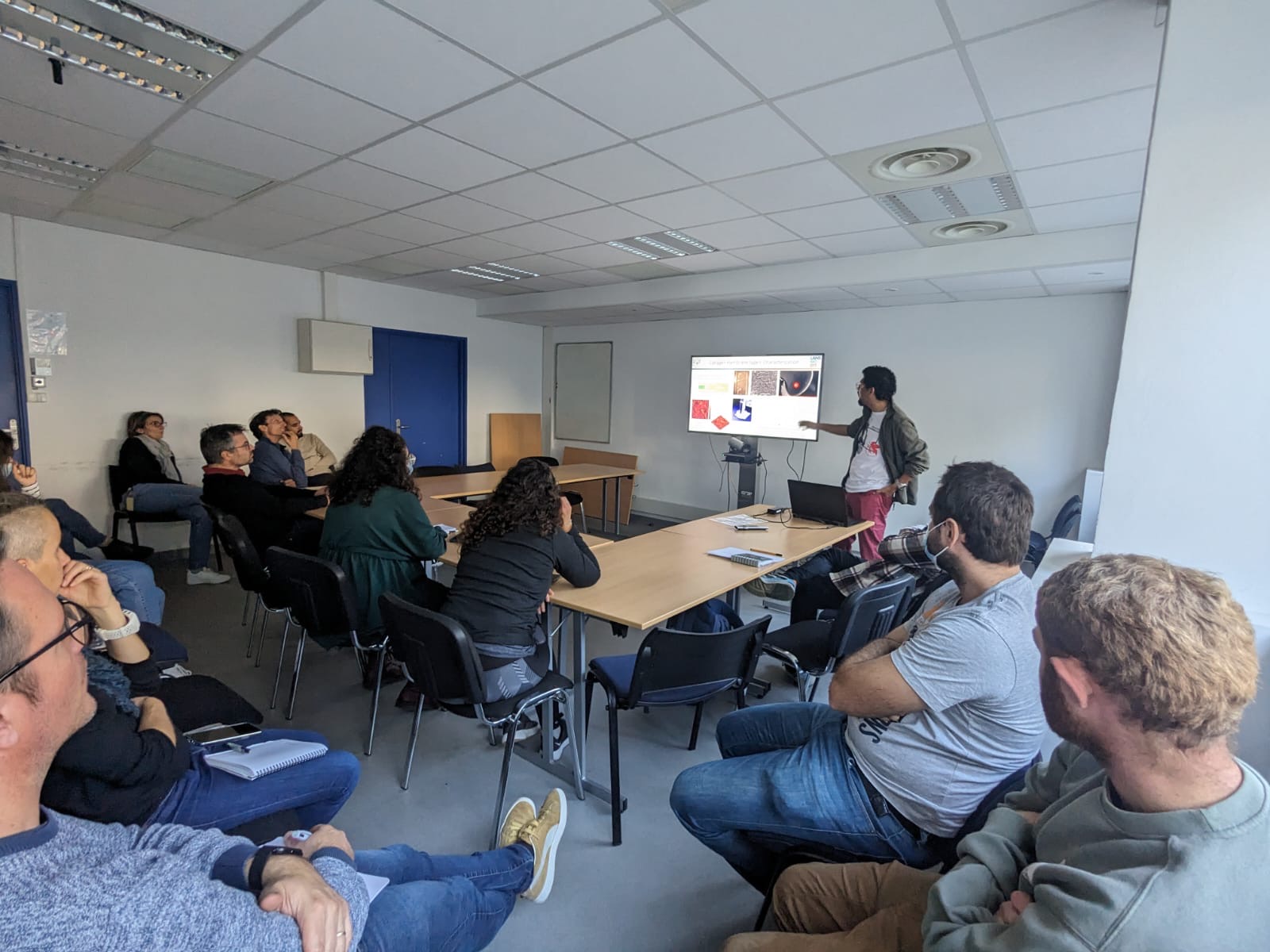
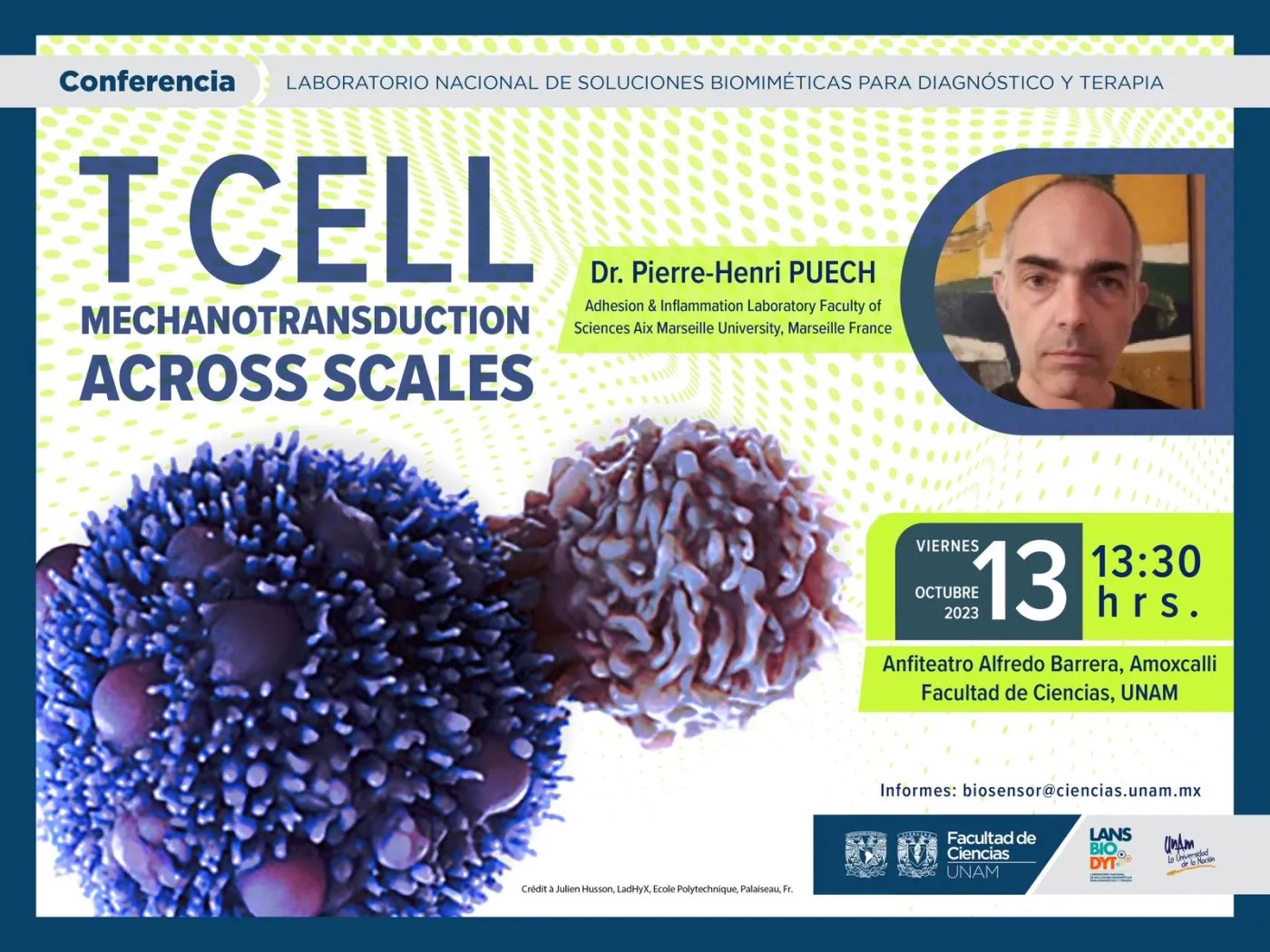
Presenting Talks at LansBioDyT, Mexico as a Component of the International Research Project (IRP) – CNRS

On October 13th, as an initiative by the Centre national de la recherche scientifique IRP, lectures were given by Laurent Limozin, Rémy Torro, Kheya Sengupta, and Pierre-Henri Puech. These lectures were dedicated to the students and researchers at the Laboratorio Nacional de Soluciones Biomiméticas para Diagnóstico y Terapia (LansBioDyT), National Autonomous University of Mexico (UNAM), where plans for experiments, exchange techniques, and much more was shared.

A new article on probing mechanical interaction of immune receptors and cytoskeleton by membrane nanotube extraction

The role of force application in immune cell recognition is now well established, the force being transmitted between the actin cytoskeleton to the anchoring ligands through receptors such as integrins. In this chain, the mechanics of the cytoskeleton to receptor link, though clearly crucial, remains poorly understood. To probe this link, we combine mechanical extraction of membrane tubes from T cells using optical tweezers, and fitting of the resulting force curves with a viscoelastic model taking into account the cell and relevant molecules. We solicit this link using four different antibodies against various membrane bound receptors: antiCD3 to target the T Cell Receptor (TCR) complex, antiCD45 for the long sugar CD45, and two clones of antiCD11 targeting open or closed conformation of LFA1 integrins. Upon disruption of the cytoskeleton, the stiffness of the link changes for two of the receptors, exposing the existence of a receptor to cytoskeleton link—namely TCR-complex and open LFA1, and does not change for the other two where a weaker link was expected. Our integrated approach allows us to probe, for the first time, the mechanics of the intracellular receptor–cytoskeleton link in immune cells.

https://doi.org/10.1038/s41598-023-42599-9

Welcome Aurélien DUMETRE and Magali CASANOVA to Our Research Team!

We are delighted to announce the newest additions to our research team, Aurélien Dumetre and Magali Casanova! With great enthusiasm, we extend a warm welcome to them as they join us in our quest for cutting-edge research and innovation.

Aurélien Dumetre, an associate professor in parasitology at Aix-Marseille University, brings invaluable expertise to our team. His focus on studying host-pathogen interactions, with current research spanning mechanobiology of coccidia, responses to food and water decontamination treatments, and transport dynamics of coccidia in soils. Aurélien also has a keen interest in amoeba-pathogen interactions.

Magali Casanova, also an associate professor in parasitology at Aix-Marseille University, contributes her expertise in amoeba-pathogen interactions at the molecular and cellular scales. Her research, covering phagocytosis, migration, and cytoskeleton reorganization in response to environmental modifications.

Together, Aurélien and Magali will undoubtedly contribute significantly to our ongoing projects and further elevate the scientific endeavors at LAI.

Welcome to the team! We are grateful for your decision to join us and look forward to the exciting journey ahead.