A new article on lymphocyte swimming in Biophysical Journal 

SIGNIFICANCE Leukocytes have a ubiquitous capacity to migrate on or in solid matrices and with or without adhesion, which is instrumental to fight infections. The precise mechanisms sustaining migration remain, however, arguable. It is for instance widely accepted that leukocytes cannot crawl on two-dimensional substrates without adhesion. In contrast, we showed that human lymphocytes swim on nonadherent two-dimensional substrates and in suspension. Furthermore, our experiments and modeling suggest that propulsion hardly rely on cell body deformations and predominantly on molecular paddling by transmembrane proteins protruding outside the cell. For physics, this study reveals a new type of microswimmer, and for biology, it suggests that leukocyte’s ubiquitous crawling may have evolved from an early machinery of swimming shared by various eukaryotic cells.

Biophysical Journal 119, 1157–1177, September 15, 2020 1157


This paper was commented on in Science (link), CellPress (link), Eurekalert (link) and Science&Vie (link) and CNRS (link).

A new article on reverse adhesive haptotaxis mecanism performed by human T lymphocytes in Journal of Cell Science

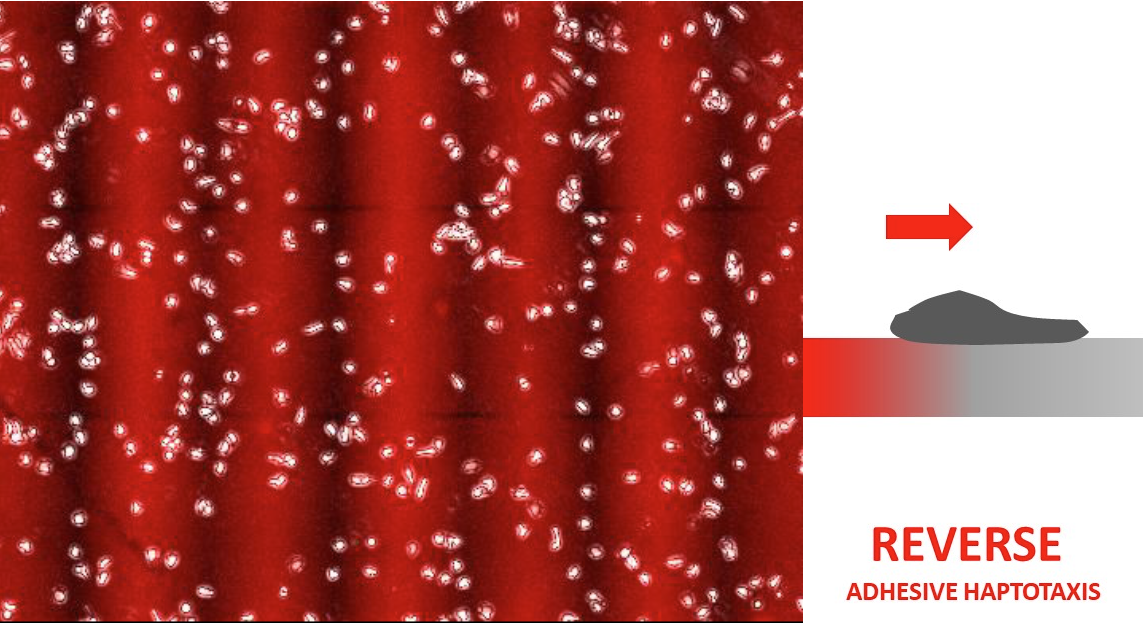
Cell guidance by anchored molecules, or haptotaxis, is crucial in development, immunology and cancer. Adhesive haptotaxis, or guidance by adhesion molecules, is well established for mesenchymal cells such as fibroblasts, whereas its existence remains unreported for amoeboid cells that require less or no adhesion in order to migrate. We show that, in vitro, amoeboid human T lymphocytes develop adhesive haptotaxis mediated by densities of integrin ligands expressed by high endothelial venules. Moreover, lymphocytes orient towards increasing adhesion with VLA4 integrins (also known as integrin α4β1), like all mesenchymal cells, but towards decreasing adhesion with LFA-1 integrins (also known as integrin αLβ4), which has not previously been observed. This counterintuitive ‘reverse haptotaxis’ cannot be explained by existing mechanisms of mesenchymal haptotaxis involving either competitive anchoring of cell edges under tension or differential integrin-activated growth of lamellipodia, because they both favor orientation towards increasing adhesion. The mechanisms and functions of amoeboid adhesive haptotaxis remain unclear; however, multidirectional integrin-mediated haptotaxis might operate around transmigration ports on endothelia, stromal cells in lymph nodes, and inflamed tissue where integrin ligands are spatially modulated.

https://doi.org/10.1242/jcs.24288

Left : T cells on repetition of adhesion gradients of integrin lagands. Right- T cells migrate toward lower adhesion on ICAM-1 lignads.

A new article on T cells response to substrate elasticity in PNAS

Researchers from LAI and CINAM have joined their efforts to study how T-lymphocytes sense the mechanics of their underlying substrate in vitro, an important but poorly understood question. Using a wide range of stiffnesses for substrates covered with antibodies against T-Cell receptors, they observed that T-cell spread more on increasingly stiff substrates, until a maximal stiffness, where they start to spread less. This is reconciling apparent contradictory results from the literature. It was also observed that involvement of integrins in this process reestablish a monotonous response, as observed for non-immune cells. The observations are rationalized in terms of a simple quantitative clutch model which will be further tested.

https://doi.org/10.1073/pnas.1811516116

A new article on three-dimensional reconstruction of the cell lamellipod without need of fluorescent labelling by using Interferential Nanoscopy in Nano Letters

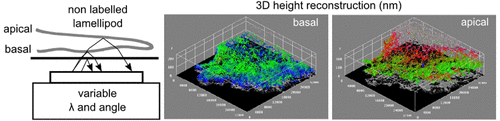
Long-time expertise of LAI  (in collaboration with CINAM) in Reflection interference contrast microscopy have recently permitted a new advance to perform nanometer scale mapping of the cell lamellipod in vitro. Combining multicolor RICM with in silico reconstruction and using optical modeling, the topography of the upper and lower membrane of a lamellipod was reconstructed, as well as the refractive index mapped. These measurements were successfully compared with independent determinations using Atomic Force Microscopy or Quantitative Phase Imaging which both provide only a partial information.

https://doi.org/10.1021/acs.nanolett.8b03134

3D representations of basal membrane (left: seen from under) and of apical membrane (right : seen from top).

Nature Article released with LAI participation

The group of Tam Mignot, with which O. Theodoly has been collaborating for 10 years, is pursuing his leading research activity on the mechanisms of micro-organisms motility. A novel paper in the journal Nature with association of LAI for technical support on microscopy experiments has just been published: “The mechanism of force transmission at bacterial focal adhesion complexes”, Volume: 539, Issue: 7630, Pages: 530, DOI: 10.1038/nature20121, Published: NOV 24 2016.

A new article on excystation and differentiation of T. gondii sporozoites into tachyzoites mediated by macrophages interactions in Scientific reports

Toxoplasma gondii is a common parasite of humans and animals, which is transmitted via oocysts in cat faeces or tissue cysts in contaminated meat. Given the resistance of the oocyst wall to digestive enzymes and the ability of oocysts to cause parenteral infections, the present study investigated the possible contribution of macrophages in supporting sporozoite excystation following oocyst internalisation. By using single cell micromanipulations, real-time and time-point imaging techniques, we demonstrated that RAW macrophages could interact rapidly with oocysts and engulfed them by remodelling of their actin cytoskeleton. Internalised oocysts were associated to macrophage acidic compartments and showed evidences of wall disruption. Sporozoites were observed in macrophages containing oocyst remnants or in new macrophages, giving rise to dividing tachyzoites. We highligh an unexpected role for the macrophage in facilitating the excystation and differentiation of T. gondii sporozoites following oocyst internalisation.

https://www.nature.com/articles/srep33654

Follow-up of the complete internalisation of one oocyst by a micropipette-held macrophage. Scale bar: 10μm