A new article on lymphocyte swimming in Biophysical Journal 

SIGNIFICANCE Leukocytes have a ubiquitous capacity to migrate on or in solid matrices and with or without adhesion, which is instrumental to fight infections. The precise mechanisms sustaining migration remain, however, arguable. It is for instance widely accepted that leukocytes cannot crawl on two-dimensional substrates without adhesion. In contrast, we showed that human lymphocytes swim on nonadherent two-dimensional substrates and in suspension. Furthermore, our experiments and modeling suggest that propulsion hardly rely on cell body deformations and predominantly on molecular paddling by transmembrane proteins protruding outside the cell. For physics, this study reveals a new type of microswimmer, and for biology, it suggests that leukocyte’s ubiquitous crawling may have evolved from an early machinery of swimming shared by various eukaryotic cells.

Biophysical Journal 119, 1157–1177, September 15, 2020 1157


This paper was commented on in Science (link), CellPress (link), Eurekalert (link) and Science&Vie (link) and CNRS (link).

A new article on reverse adhesive haptotaxis mecanism performed by human T lymphocytes in Journal of Cell Science

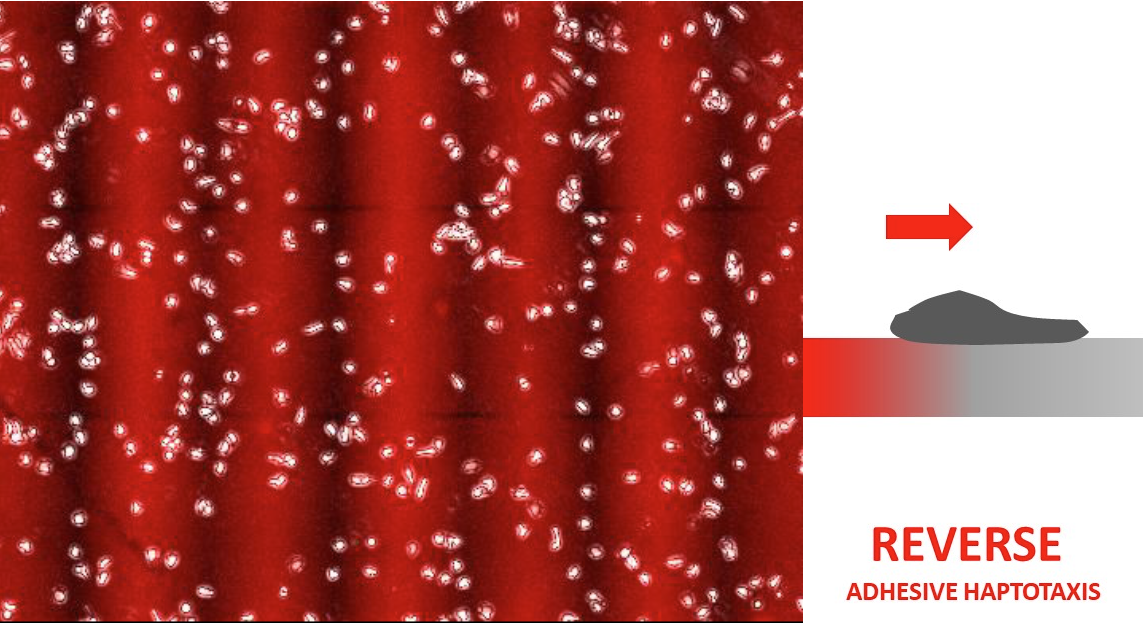
Cell guidance by anchored molecules, or haptotaxis, is crucial in development, immunology and cancer. Adhesive haptotaxis, or guidance by adhesion molecules, is well established for mesenchymal cells such as fibroblasts, whereas its existence remains unreported for amoeboid cells that require less or no adhesion in order to migrate. We show that, in vitro, amoeboid human T lymphocytes develop adhesive haptotaxis mediated by densities of integrin ligands expressed by high endothelial venules. Moreover, lymphocytes orient towards increasing adhesion with VLA4 integrins (also known as integrin α4β1), like all mesenchymal cells, but towards decreasing adhesion with LFA-1 integrins (also known as integrin αLβ4), which has not previously been observed. This counterintuitive ‘reverse haptotaxis’ cannot be explained by existing mechanisms of mesenchymal haptotaxis involving either competitive anchoring of cell edges under tension or differential integrin-activated growth of lamellipodia, because they both favor orientation towards increasing adhesion. The mechanisms and functions of amoeboid adhesive haptotaxis remain unclear; however, multidirectional integrin-mediated haptotaxis might operate around transmigration ports on endothelia, stromal cells in lymph nodes, and inflamed tissue where integrin ligands are spatially modulated.

https://doi.org/10.1242/jcs.24288

Left : T cells on repetition of adhesion gradients of integrin lagands. Right- T cells migrate toward lower adhesion on ICAM-1 lignads.

LAI welcomes new postdoc!

Dalia El Arawi started her LAI journey during COVID19 lockdown on the physical and computational aided design of bispecific antibodies for cancer immunotherapy under the supervision of Laurent Limozin. Her main objective will consist of testing bispecific antibodies using in vitro Antibody Dependent Cell Cytotoxicity mediated by NK cells employing TIRFM and RICM.

LAI welcomes new PI!

The lab is excited to have Arnauld Sergé joining its researchers staff. Arnauld is an associate professor in Biology and Physics at AMU. His research is centered on membrane dynamics using single-molecule microscopy and image analysis, with his current project focusing on « Dynamic videonanoscopy of immuno-cancer interactions ».