
To quantify the stresses, forces and energies that T cells exert during the early stages of recognition and potential activation traction force microscopy (TFM). This technique uses nano beads immerged in an elastic substrate : when the cell pulls on the substrates, the beads that are in the vicinity move. From this motion, and knwoing the elasticity of the substrate, usually a gel, one can infer the local mechanical stresses the cells are exerting.
During the thesis of F. Mustapha, we documented and published the detailled protocols for producing very soft PAA gels, well characterized mechanically, with a high density of fluorescent nanobeads and reproducible, together with the open source solutions and homemade scripts to quantify the obtained data.
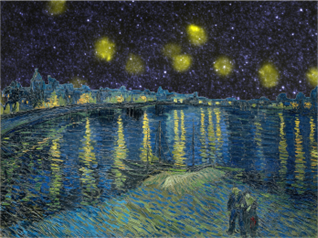
Fig: The ImmunoBioPhysicist Starry Night Over the Rhône Merged image of Vincent Van Gogh 1888 painting, Lifeact-GFP T cells (yellow) sitting on a ultra-soft polyacrilamide gel (purple), doped with sub-resolution beads (white dots), serving as stress reporters.
Protocol for measuring weak cellular traction forces using well-controlled ultra-soft polyacrylamide gels. Mustapha F, Sengupta K, Puech PH. STAR Protoc. 2022 Jan 28;3(1):101133. doi: 10.1016/j.xpro.2022.101133 Cellular forces during early spreading of T lymphocytes on ultra-soft substrates. Farah Mustapha, Martine Biarnes-Pelicot, Remy Torro, Kheya Sengupta, Pierre-Henri Puech. bioRxiv. doi: link
 Adhesion & Inflammation Lab
You must be logged in to post a comment.