
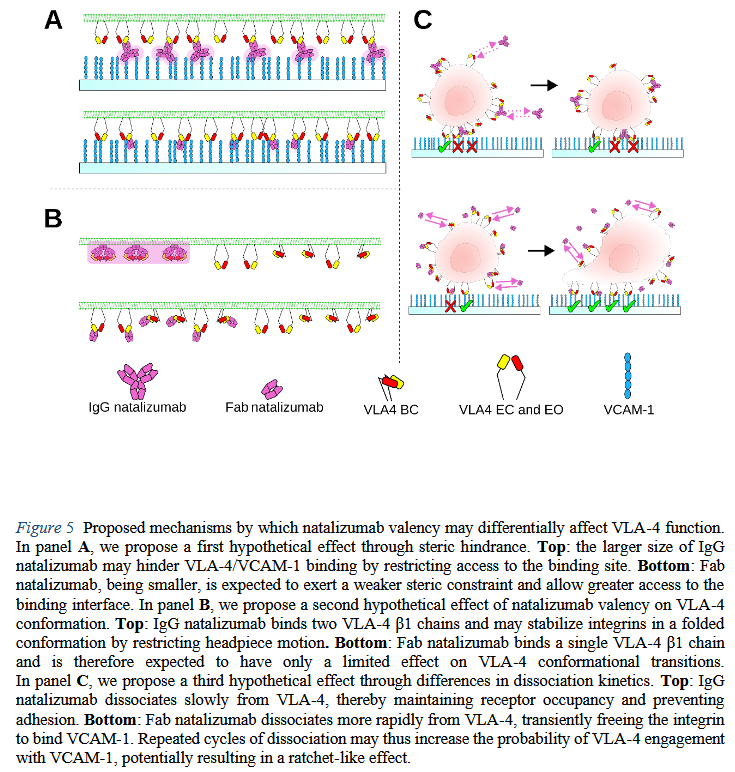
We are pleased to announce the publication of a new article entitled “Bivalency of natalizumab promotes inhibition of dynamic VLA-4 adhesion beyond affinity gain.”
This publication holds a very special place for us, as it represents the final scientific work of our colleague Dominique Touchard, who passed away in January 2025.
Working with Dominique was always a pleasure. Our collaborations with her were constructive, efficient and full of enthusiasm. Beyond the science, we also remember with great affection the many joyful moments we shared with her, especially over lunch.We miss her greatly, and we are very happy to see this work, to which she contributed so much, now published.
Abstract : This study shows how natalizumab functionally inhibits α4β1 (very late antigen-4, VLA-4)–mediated T-cell adhesion by integrating quantitative affinity measurements with dynamic assays performed under shear stress. We show that the antibody’s bivalency provides a major functional advantage, enabling strong inhibition of cell capture and adhesion at concentrations near its EC50 (half-maximal effective concentration), whereas monovalent Fab fragments require 10- to 100-fold higher doses. These findings offer biological insight into why receptor occupancy alone cannot predict adhesion inhibition. By combining cell-based affinity quantification with real-time adhesion and migration assays, our work reveals how kinetic and geometric properties of antibody–integrin interactions shape immune cell dynamics, informing the rational design of next-generation integrin-targeting therapeutics.
https://doi.org/10.1093/intbio/zyag015



You must be logged in to post a comment.