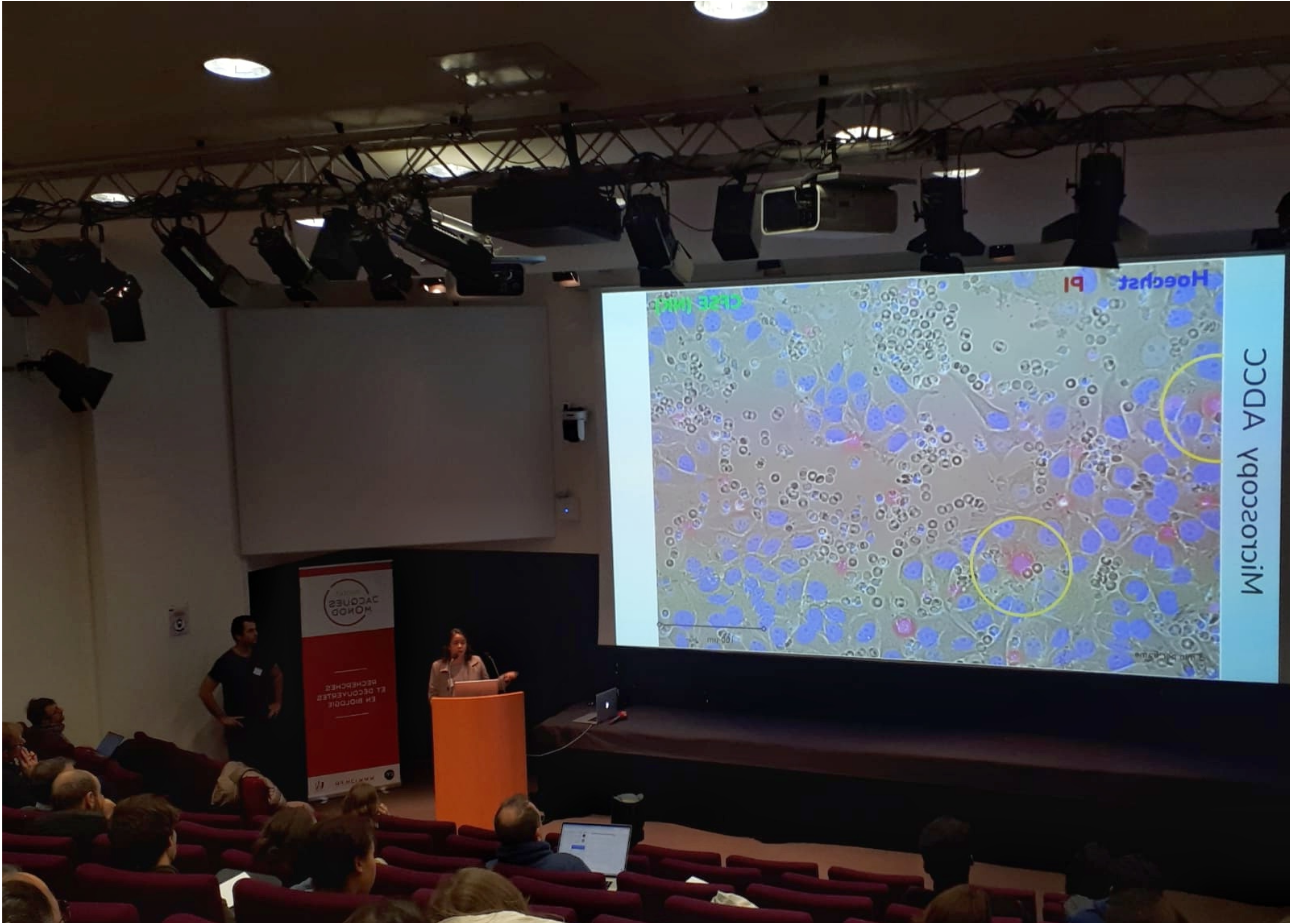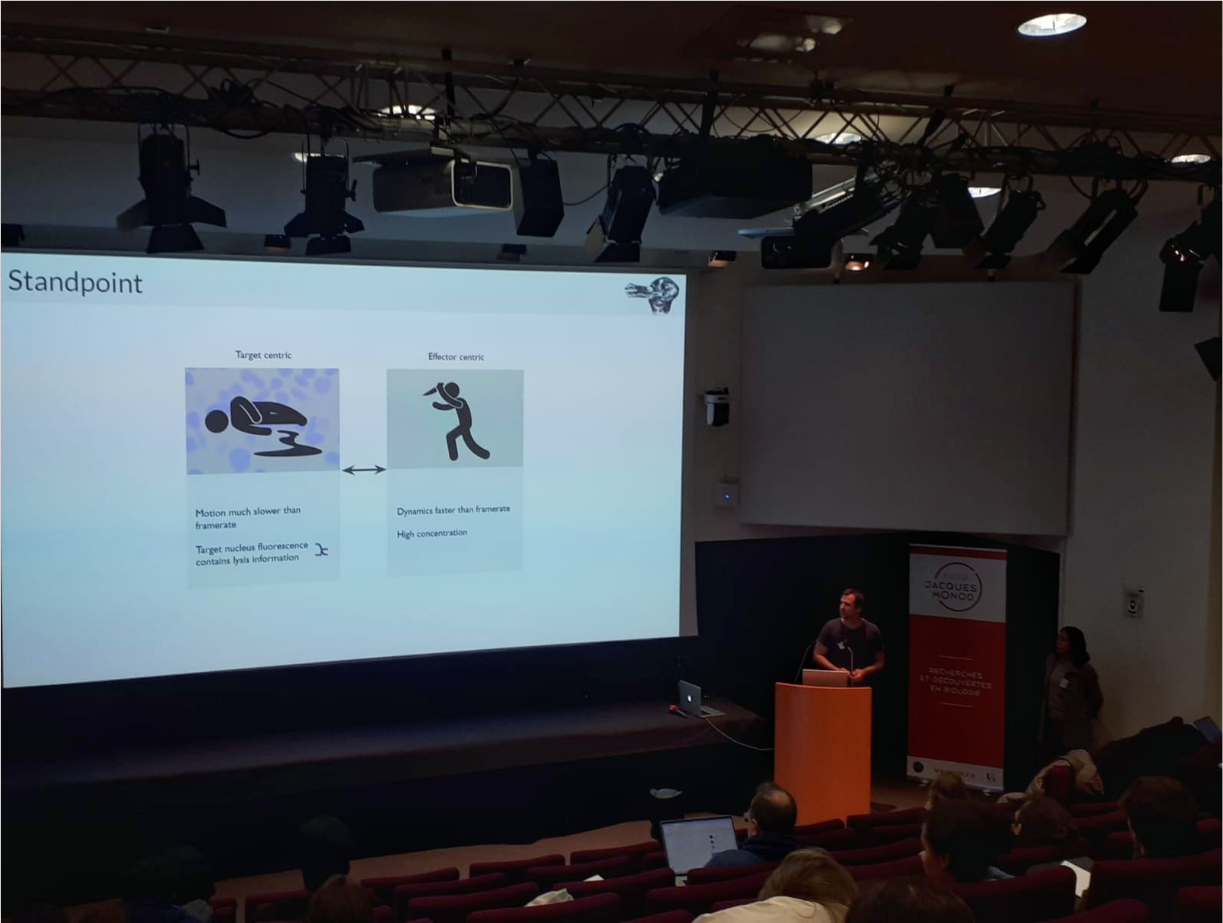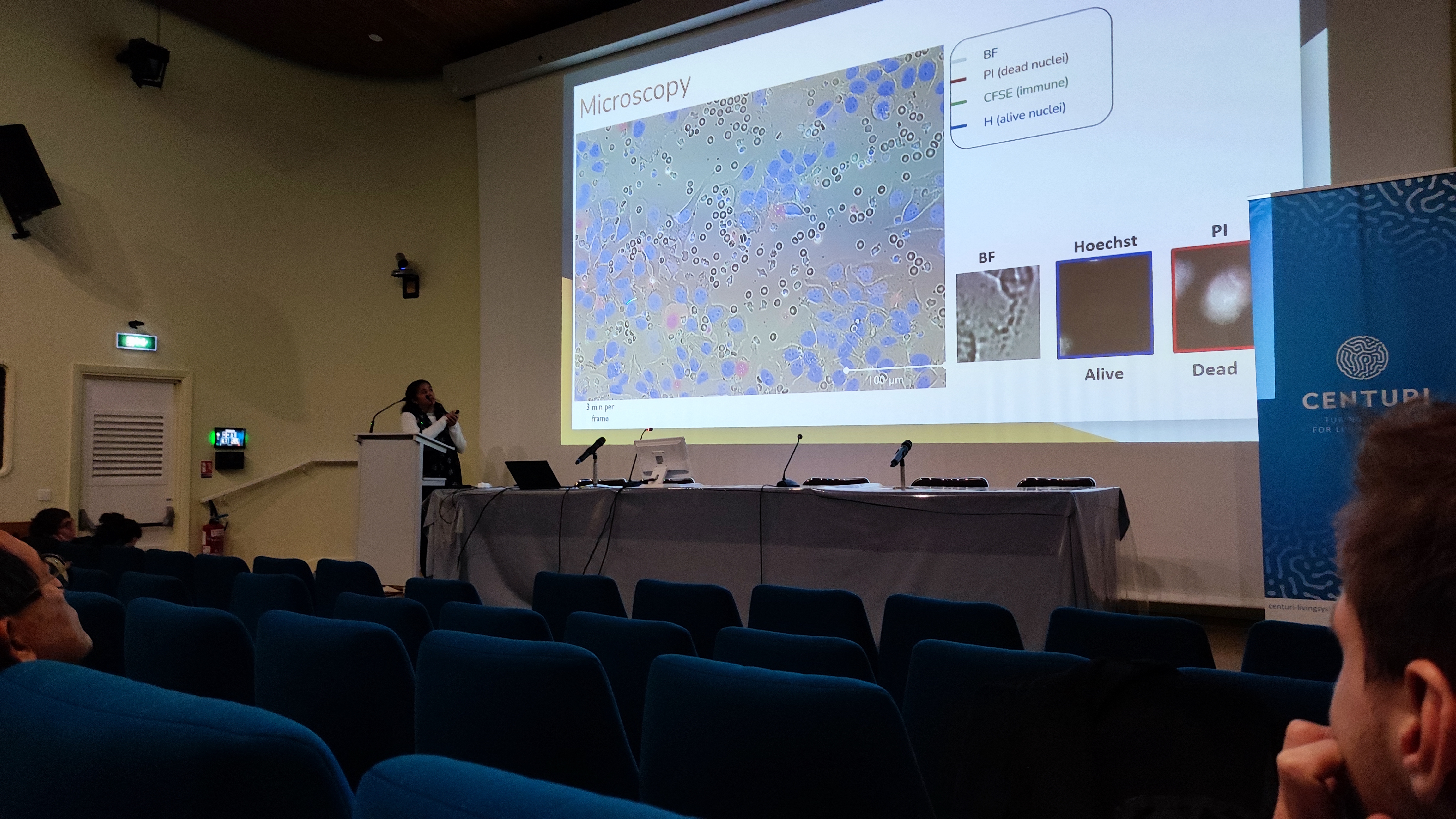
Beatriz Díaz Bello and Rémy Torro participated at the New Microscopies in Cell Biology at Institut Jacques Monod in Paris where they co-presented a talk entitled “A deep learning-based software to measure immune cytotoxicity, in single cells, over time”, a co-presentation that highlights the interdisciplinary pursued at LAI and the constant back and forth between biologists and physicists. The conference was co-organized by Pierre-Henri Puech.
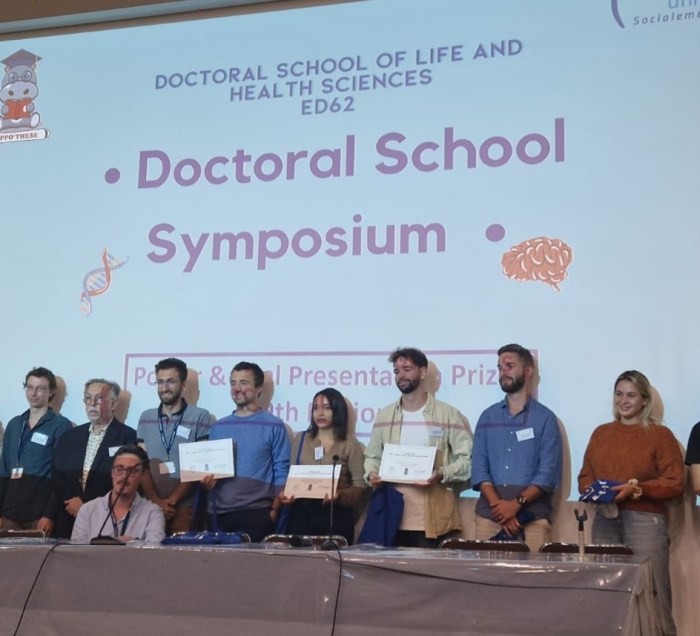
Our PhD students Ismahene Mesbah and Elodie Lafargue participated in the Doctoral School Symposium of ED62 (Life and Health Sciences) with Ismahene winning 2nd prize for best oral presentation and Elodie winning the poster’s prize. Congratulations to our future Drs!
Flash talk – DIAZ BELLO Beatriz (LAI): A deep learning-based modular software to locate, track and measure single-cell ADCC over time.
Flash talk – NUÑEZ VIADERO EIDER (LAI): Development of the state of the art technology to monitor protein-folding in real time under physiological conditions.
Flash talk – ROBERT Philippe (LAI): On and off-rates measurements at the single molecular level with laminar flow chamber: a need for new links and linkers.
Valentine started her journey at LAI as an intern, and this week we’ve had the privilege of witnessing the fruit of her work. Valentine defended her Ph.D. project entitled “Quantitative study of cell guidance in controlled microenvironments: atypical cases of rheotaxis and adhesive haptotaxis” in front of the jury composed of: Nicolas Biais, Charlotte Rivière, Ana Labernadie et Matthieu Piel. Congratulations Valentine and we look forward to having you around as an engineer after the well-deserved break!
Dr. Anna Labernadie “From mechanobiology to bioengineering approaches: addressing the role of the tumor microenvironment in cancer spreading and immunotherapy outcomes” Amphi 12
Cellular guidance by chemical or physical signals is essential for many life processes and usually relies on sophisticated biological processes that are still partially elucidated. Microfluidic experiments and mechanical modeling has revealed that the choice for cells to orient themselves against or in the direction of a flow can result from a simple physical bias. They have worked with keratocytes, cells that form the scale of fishes, and whose morphology is characterized by broad flat “front” and a compact protruding front “back”. A simplified model of a cell with a hemispherical back and a flat rectangular front allows to quantitatively calculate the forces that the flow exerts on each edge. The resulting force stabilizes the cells with a large rear edge against the flow, like a roly-poly that stays upright because of its heavy bottom edge. The researchers’ model successfully predicted the experimentally observed orientation for each cell without adjusting parameter. It is an elegant example where a characterized biological behavior does not result from specialized molecular sensors and a complex cascade of internal biosignals to reorient the cell, but from a simple passive physical bias.
A– Keratocytes descending a flow, the white arrow indicates the direction of the stream. B– Cell morphology seen in 3D by confocal microscopy, with a bulbous back edge and a flat, thin front edge. C– Cell modeling with a hemisphere at the back (red) and a flat rectangle at the front (brown) D– The torques resulting from flow on cell front (red arrow) and cell front (brown arrow) stabilize upstream orientation of cell with larger rear edge, like the torque resulting from gravity stabilizes the standing position of roly-poly toys with large bottom edge.
We are pleased to welcome for two months Andrzej Kubiak, a visiting post-doc from the Jagiellonian University in Polland. Andrzej’s is mainly interested in hematopoietic stem cells and will be collaborating with Pierre-Henri Puech on an application of single-cell force spectroscopy to investigate adhesion within the bone marrow.
The BioPhysImmuno IRP project aims to continue a successful collaboration started through a CNRS Projet International de Coopération Scientifique (PICS) project (20218-2021) between two complementary laboratories, one located in Mexico and one in France. The project has been launched with Pierre-Henri Puech acting as coordinator!
You must be logged in to post a comment.