A new article on AI Tools for Immunofluorescence-Based Diagnostics

We are excited to share our latest research published in the International Journal of Molecular Sciences: “Comparison of the Capacity of Several Machine Learning Tools to Assist Immunofluorescence-Based Detection of Anti-Neutrophil Cytoplasmic Antibodies.”

This work was conducted in collaboration with Daniel Bertin and Nathalie Bardin, both members of the Immunology Laboratory of Marseille Hospitals, and Pierre Bongrand from LAI.

This study addresses a current challenge of using artificial intelligence to perform biomedical tasks without any human intervention, which might result in lower cost, increased availability and increased rapidity. Here, we compared the capacity of several widely available machine learning tools to analyze microscopic images in order to diagnose some autoimmunity diseases. The paper described preliminary results obtained with a dataset of 1,733 cell images.

For more information, visit the publication: https://doi.org/10.3390/ijms25063270.

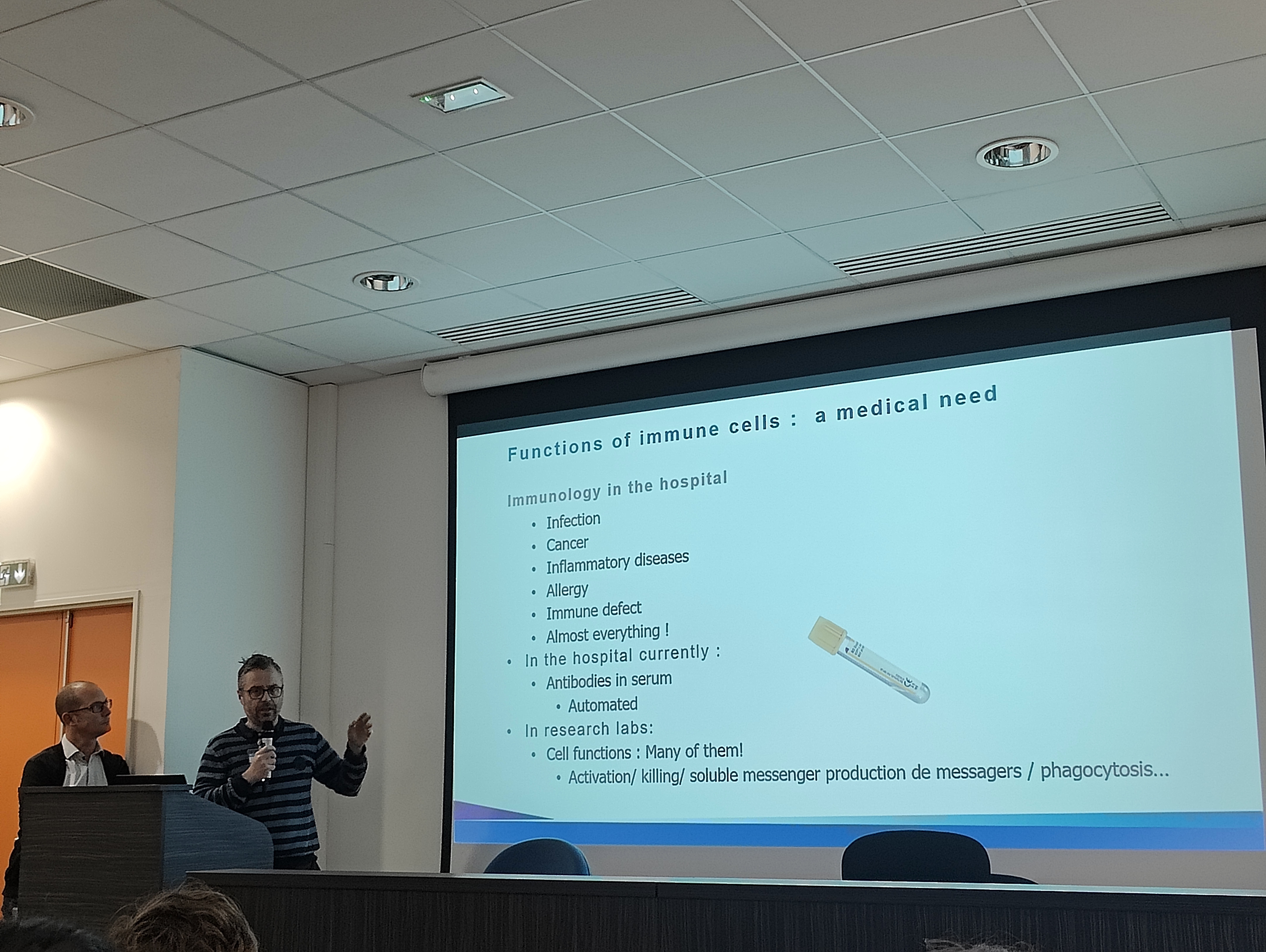
Transforming Cell Assays: Bridging Science and Hospital Needs

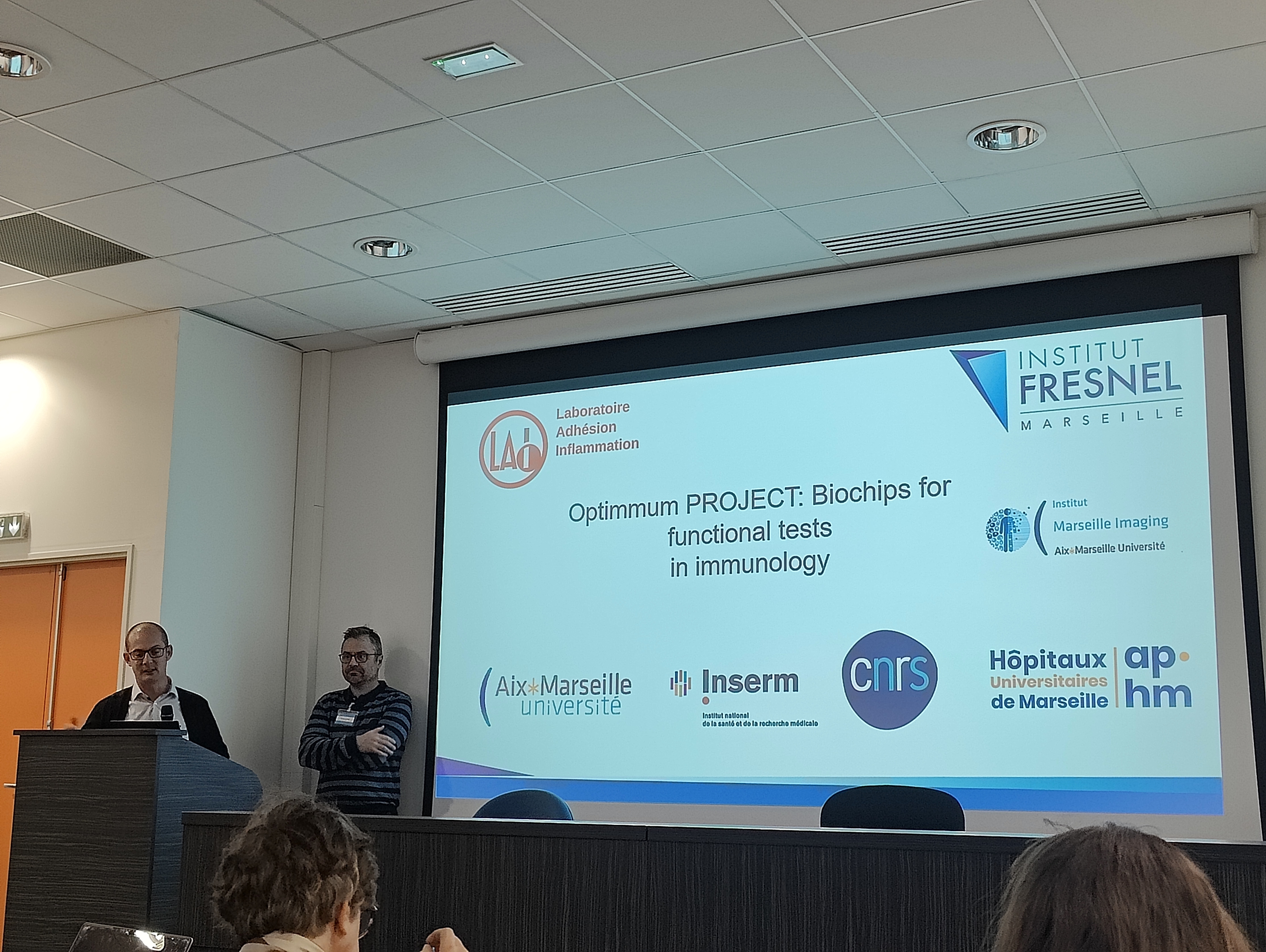
Annual scientific day of Aix-Marseille University Imaging Institute took place February 23rd. Laureates of the 2023 call for interdisciplinary projects presented the progress of the past year of their respective projects. Among them, a collaborative project gathering Julien Lumeau, Fabien Lemarchand, Antonin Moreau from Fresnel Institute in Marseilles and Marie-Pierre Valignat, Olivier Theodoly and Philippe Robert from LAI was presented. It focuses on coupling micropatterned cellular assays from LAI to anti-reflexive surfaces produced by Fresnel Institute to detect protein secretion by cells, to obtain marker-less, manipulation-less and real-time assays adapted to routine hospital use.

LAI celebrates Marc Karnat’s thesis (Visiting PhD Student from CPT)

Marc did his Ph.D. under the supervision of Jean-Francois Rupprecht at CPT (kindly hosted at LAI) and funded by CENTURI. On monday, 18th December, he successfully defended his thesis which is entitled “Inferring the rheology of cellular materials through dedicated deep learning tools” in front of an expert jury consisting of Romain Levayer, Hervé Turlier, Hélène Delanoë-Ayari, Bianca Habermann, Thierry Artières and Sham Tlili.

Luckily, he’ll stay with us for a few months in 2024 to finish his project and we wish him the best of luck in his future. Again, Congratulations Marc for your incredible work !!

Christmas Festivities !

This December, the LAI team celebrated the holiday season in a special and memorable way. Members of the lab from around the world organized an international feast to highlight the varied culinary traditions of our team. It was a day full with laughter and a variety of flavors, representing our collective journey through a great year. Here’s to the memories we’ve made and the thrilling adventures that await us!

LAI celebrates Achyuth Acharya’s thesis!

On the 11th of December, Achyuth Acharya successfully defend his work titled ‘Multiscale Characterization of Human Muscle Differentiation in vitro and the Influence of Mechanical Stimuli‘. The defense took place in front of a distinguished jury comprising experts in the field: Edgar Gomes, Delphine Duprez, Sylvain Gabrielle, and Sophie Chauvet.

Achyuth began his journey with IBDM and LAI as a Centuri student under the guidance of Frank Schnorrer from IBDM and Olivier Theodoly from LAI. He has now advanced to the next stage of his academic journey. He will be continuing his impactful project as a post-doc at IBDM, and we extend our heartfelt congratulations and best wishes to him.

Best of luck, Achyuth!

Congratulations Martine Biarnes Pelicot (our amazing engineer) for your contribution to the book “Etonnante physique” published by CNRS !!

We are delighted to inform you that our engineer, Martine Biarnes Pelicot, has contributed to the book “Etonnante physique” published by CNRS. In her article, Martine explains how genetic engineering enables her to create tailor-made tools for studying the biophysics of immune cells.

This book brings together 70 contributions from physicists who have recently been awarded a CNRS medal. The book offers a captivating exploration of the many areas covered by this surprising discipline. It is designed to be accessible to all those who are curious about science.

We invite you to discover this fascinating book by following the link below: https://anneedelaphysique.cnrs.fr/ressource/etonnante-physique/”

CNRS IRP : Aaron Cruz-Ramirez is visiting LAI

We are happy to welcome Aarón Cruz Ramírez, who runs the micro- and nano-fabrication facilities at the National Autonomous University of Mexico (UNAM).

During his visit, we had the pleasure of showcasing force-based techniques. Aarón also demonstrated his craftsmanship by creating nanoscribe surfaces, including a small surface featuring the LAI logo. To top it off, he shared valuable insights into his impressive work with our lab.

Valentine Seveau de Noray wins prestigious “Accessit du Prix Daniel Guinier” from SFP for her outsanding research!

We are delighted to share the remarkable achievement of Valentine Seveau de Noray, who has been honored with the “Accessit au prix Daniel Guinier” for the year 2022. This prestigious award is presented annually by the French Physical Society (SFP) to young physicists for their exceptional research during their doctoral studies.

Valentine’s dedication and innovative contributions to the field have earned her a second prize, a testament to her unwavering commitment to advancing scientific knowledge. Valentine finished her thesis “Quantitative study of cell guidance in controlled microenvironments: atypical cases of rheotaxis and adhesive haptotaxis” under the guidance of Olivier Theodoly and Marie-Pierre Valignat.

Congratulations, Valentine!

For more details on Valentine’s research and the award, please visit the link below: http://sfpnet.fr/baptiste-bienvenu-et-valentine-seveau-de-noray-accessits-aux-grands-prix-de-these-2022-de-la-sfp

A new article on Naive T lymphocytes chemotax long distance to CCL21 but not to a source of bioactive S1P in Iscience

Naive T lymphocytes traffic through the organism in search for antigen, alternating between blood and secondary lymphoid organs. Lymphocyte homing to lymph nodes relies on CCL21 chemokine sensing by CCR7 receptors, while exit into efferent lymphatics relies on sphingolipid S1P sensing by S1PR1 receptors. While both molecules are claimed chemotactic, a quantitative analysis of naive T lymphocyte migration along defined gradients is missing. Here, we used a reductionist approach to study the real-time single-cell response of naive T lymphocytes to CCL21 and serum rich in bioactive S1P. Using microfluidic and micropatterning ad hoc tools, we show that CCL21 triggers stable polarization and long-range chemotaxis of cells, whereas S1P-rich serum triggers a transient polarization only and no significant displacement, potentially representing a brief transmigration step through exit portals. Our in vitro data thus suggest that naive T lymphocyte chemotax long distances to CCL21 but not toward a source of bioactive S1P.

https://doi.org/10.1016/j.isci.2023.107695

Non-exhaustive model of naive T lymphocyte traffic after accessing lymph nodes. Cells are gently attracted by long-range CCL19 and CCL21 gradients toward the central parenchyma, where they encounter higher and homogeneous concentrations of CCL21 that allow their random walk throughout the T cell zone. Moreover, S1P-rich serum triggers a transient polarization only and no significant displacement, potentially representing a brief transmigration step through exit portals.