A new article on Naive T lymphocytes chemotax long distance to CCL21 but not to a source of bioactive S1P in Iscience

Naive T lymphocytes traffic through the organism in search for antigen, alternating between blood and secondary lymphoid organs. Lymphocyte homing to lymph nodes relies on CCL21 chemokine sensing by CCR7 receptors, while exit into efferent lymphatics relies on sphingolipid S1P sensing by S1PR1 receptors. While both molecules are claimed chemotactic, a quantitative analysis of naive T lymphocyte migration along defined gradients is missing. Here, we used a reductionist approach to study the real-time single-cell response of naive T lymphocytes to CCL21 and serum rich in bioactive S1P. Using microfluidic and micropatterning ad hoc tools, we show that CCL21 triggers stable polarization and long-range chemotaxis of cells, whereas S1P-rich serum triggers a transient polarization only and no significant displacement, potentially representing a brief transmigration step through exit portals. Our in vitro data thus suggest that naive T lymphocyte chemotax long distances to CCL21 but not toward a source of bioactive S1P.

https://doi.org/10.1016/j.isci.2023.107695

Non-exhaustive model of naive T lymphocyte traffic after accessing lymph nodes. Cells are gently attracted by long-range CCL19 and CCL21 gradients toward the central parenchyma, where they encounter higher and homogeneous concentrations of CCL21 that allow their random walk throughout the T cell zone. Moreover, S1P-rich serum triggers a transient polarization only and no significant displacement, potentially representing a brief transmigration step through exit portals.

A new article on OT_Analysis: a software for rich analysis of force curves when probing living cells with optical tweezers

Optical tweezers are a light-based technique for micromanipulating objects. It allows to move objects such as microbeads and cells, and to record minute forces down to a few pN, which makes it a technique very well adapted to mechanical measurements on living cells (Gennerich, 2017). We are interested in the mechanotransduction properties of lymphocytes. We seek to dissect the effect of forces and cell mechanics on the cellular response, in the context of the immune system. T cell mechanotransduction has been recently demonstrated to be instrumental in the finesse and accuracy of the response of the latter Puech & Bongrand (2021)]. In addition, cells can exert forces when performing their action, e.g. cytotoxic T cells are using forces to kill target infected cells (Basu et al., 2016).
Using optical tweezers and specifically decorated beads as handles, we pull membrane nano- tubes from gently adhered living lymphocytes (Sadoun et al., 2020). Such nanotubes are usually used to probe the tension of adherent cells (Diz-Muñoz et al., 2010). By varying the antibodies that are used to decorate the beads, we select the molecule type we specifically pull on, and we then explore the molecules which are characteristic of the immune synapse, which is one of the key organizational structures that have profound implications in T cell recognition and action (Baldari & Dustin, 2017).
Using this approach, we probe not only the forces of recognition of the given antibody to its target molecule, but also, by using strong extracellular bridges, we probe the cytosolic link of the probed molecule to the cytoskeleton. Such a link has been proposed to be instrumental in the way T cells can apply or feel forces through the molecule. A theoretical model has been built and has been recently reported in a dedicated article (Manca et al., 2023). Furthermore, we will demonstrate the application of the software on full data.

The experimentally obtained data consists of force signal as a function of time (among other parameters), in the three directions of space, obtained in large quantities (at least 10 per cell / bead couple, and up to 20 couples tested per sample), containing rich and detailed features that can relate to molecular and/or cellular mechanics that our model explores. It is therefore needed to standardize and semi-automate data analysis to help the experimentalist, often a biologist, to extract relevant features from the experimental data sets.

https://doi.org/10.21105/joss.04877

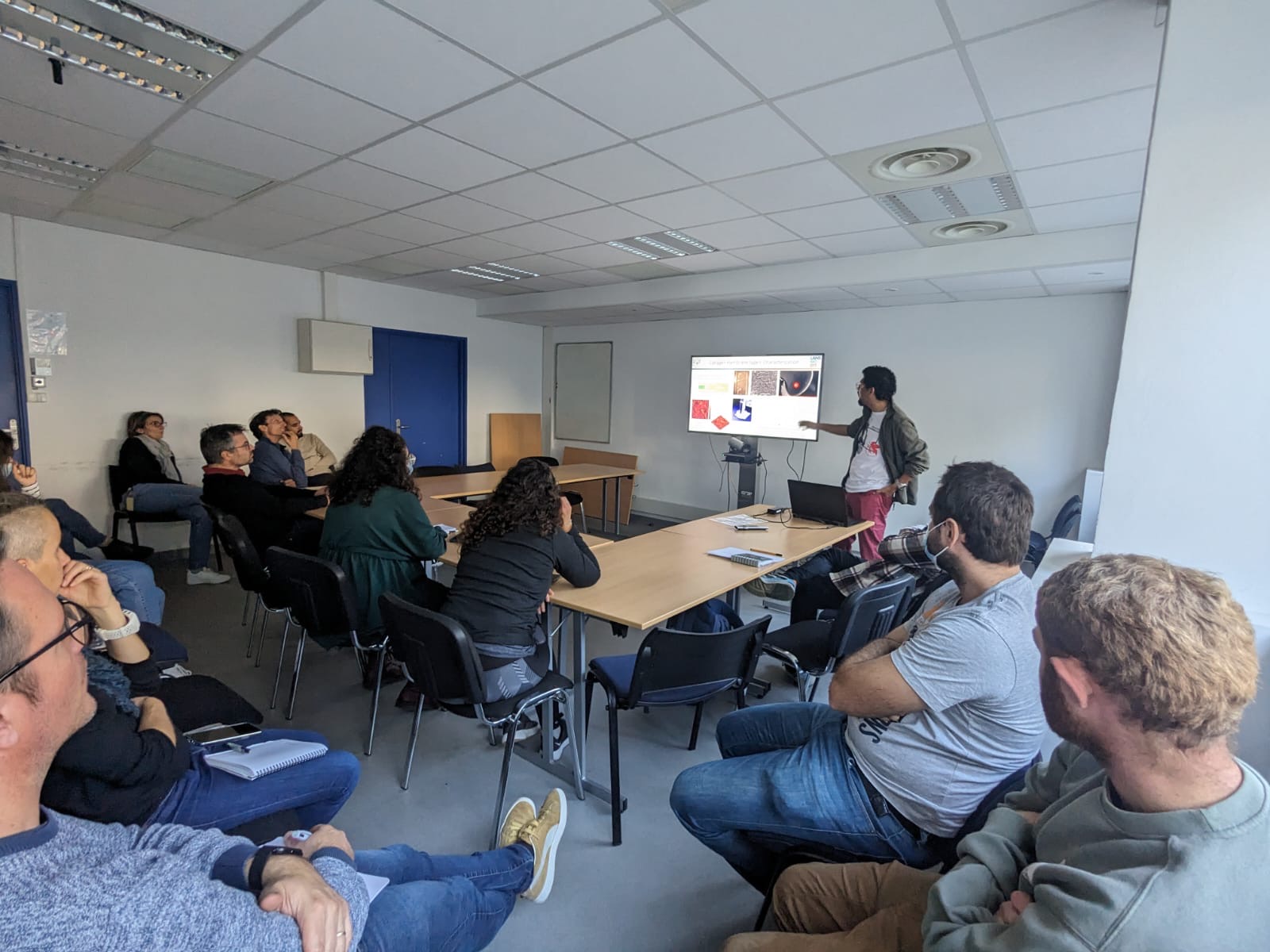
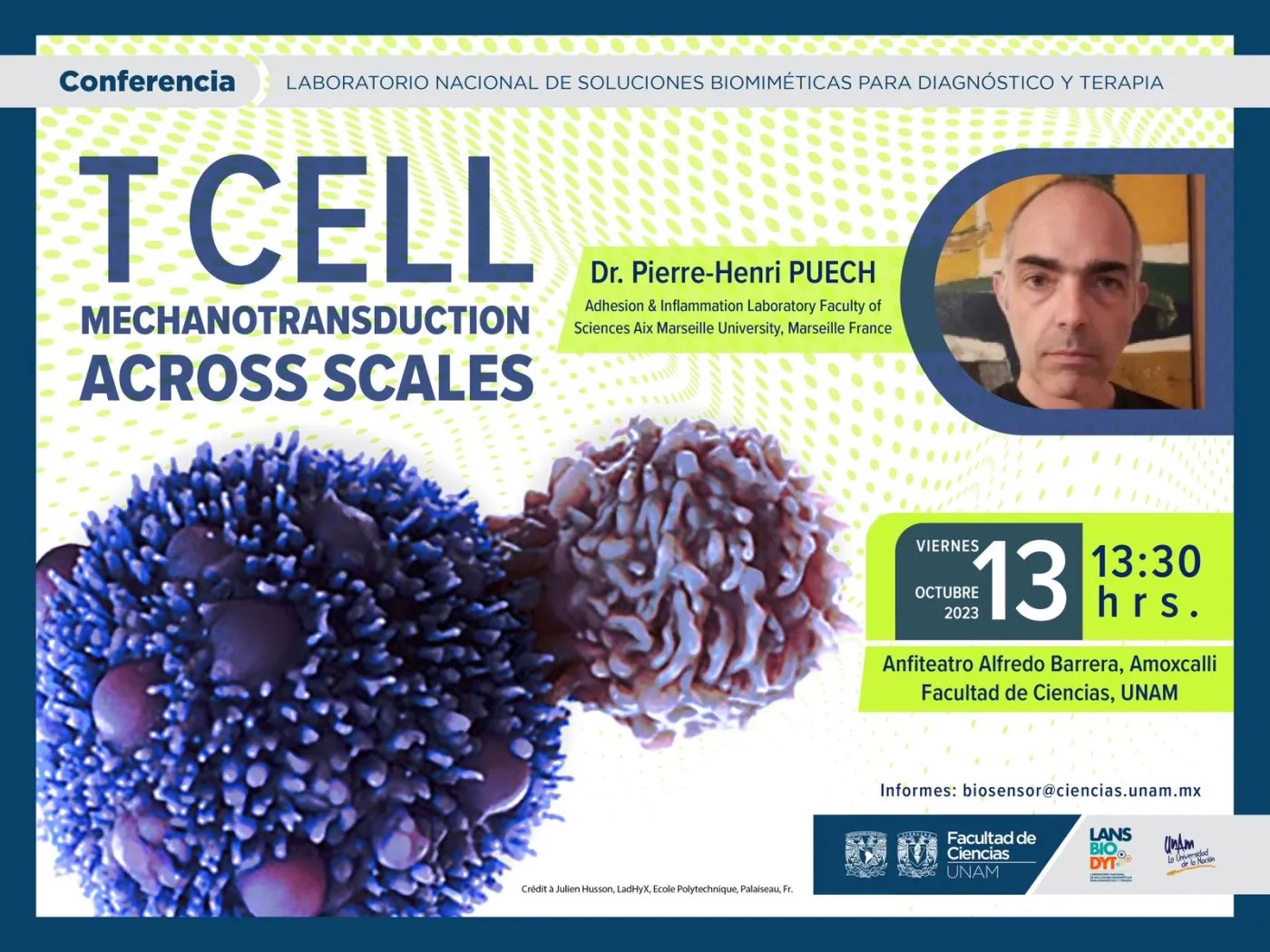
Presenting Talks at LansBioDyT, Mexico as a Component of the International Research Project (IRP) – CNRS

On October 13th, as an initiative by the Centre national de la recherche scientifique IRP, lectures were given by Laurent Limozin, Rémy Torro, Kheya Sengupta, and Pierre-Henri Puech. These lectures were dedicated to the students and researchers at the Laboratorio Nacional de Soluciones Biomiméticas para Diagnóstico y Terapia (LansBioDyT), National Autonomous University of Mexico (UNAM), where plans for experiments, exchange techniques, and much more was shared.

A new article on probing mechanical interaction of immune receptors and cytoskeleton by membrane nanotube extraction

The role of force application in immune cell recognition is now well established, the force being transmitted between the actin cytoskeleton to the anchoring ligands through receptors such as integrins. In this chain, the mechanics of the cytoskeleton to receptor link, though clearly crucial, remains poorly understood. To probe this link, we combine mechanical extraction of membrane tubes from T cells using optical tweezers, and fitting of the resulting force curves with a viscoelastic model taking into account the cell and relevant molecules. We solicit this link using four different antibodies against various membrane bound receptors: antiCD3 to target the T Cell Receptor (TCR) complex, antiCD45 for the long sugar CD45, and two clones of antiCD11 targeting open or closed conformation of LFA1 integrins. Upon disruption of the cytoskeleton, the stiffness of the link changes for two of the receptors, exposing the existence of a receptor to cytoskeleton link—namely TCR-complex and open LFA1, and does not change for the other two where a weaker link was expected. Our integrated approach allows us to probe, for the first time, the mechanics of the intracellular receptor–cytoskeleton link in immune cells.

https://doi.org/10.1038/s41598-023-42599-9

Welcome Aurélien DUMETRE and Magali CASANOVA to Our Research Team!

We are delighted to announce the newest additions to our research team, Aurélien Dumetre and Magali Casanova! With great enthusiasm, we extend a warm welcome to them as they join us in our quest for cutting-edge research and innovation.

Aurélien Dumetre, an associate professor in parasitology at Aix-Marseille University, brings invaluable expertise to our team. His focus on studying host-pathogen interactions, with current research spanning mechanobiology of coccidia, responses to food and water decontamination treatments, and transport dynamics of coccidia in soils. Aurélien also has a keen interest in amoeba-pathogen interactions.

Magali Casanova, also an associate professor in parasitology at Aix-Marseille University, contributes her expertise in amoeba-pathogen interactions at the molecular and cellular scales. Her research, covering phagocytosis, migration, and cytoskeleton reorganization in response to environmental modifications.

Together, Aurélien and Magali will undoubtedly contribute significantly to our ongoing projects and further elevate the scientific endeavors at LAI.

Welcome to the team! We are grateful for your decision to join us and look forward to the exciting journey ahead.

A new tool was developed at LAI!

In recent work, Yong Jian Wang, Claire Valotteau, and Laurent Limozin managed to combine DNA scaffolds and acoustic force spectroscopy to characterize individual protein bonds. This work has been in done in collaboration with colleagues at CRCM and IBENS.

To know more about the work, don’t hesitate to reach out to Laurent Limozin or take a look at the article: https://www.cell.com/biophysj/fulltext/S0006-3495(23)00302-8

In press: CNRS

© Vladimir Kunetki – CNRS

Welcome Andrzej & Natalia !

We are pleased to welcome for the second time Andrzej Kubiak, and for the first time, Natalia Bryniarska-Kubiak, a visiting post-doc from Jagiellonian University, Krakow, Poland.

They are joining the lab for a short stay and collaborating with Pierre-Henri Puech to learn Atomic Force Microscopy, Single-Cell Force Spectroscopy, and Traction Force Microscopy!

Welcome!

Merlin Sanicas becomes a doctor… Again!

A medical doctor by training, Merlin decided to embark on a fundamental science journey in 2019 and hasn’t looked back since. Merlin did his Ph.D. under the supervision of Patrick Chames at CRCM and Laurent Limozin at LAI. He successfully defended his thesis which is entitled “Selection of nanobodies by a microfluidic mechanical approach for therapeutic purposes” in the presence of an expert jury consisting of Marie-Alix Poul, Charlie Gosse, and Hervé Nozach.

Merlin has already been employed by Immunocore in the UK where he’s utilizing his skills in a more applied setting. We wish him the best of luck, as well as a lot of Marvel content in his future!